
What is koliva and what does it symbolise?
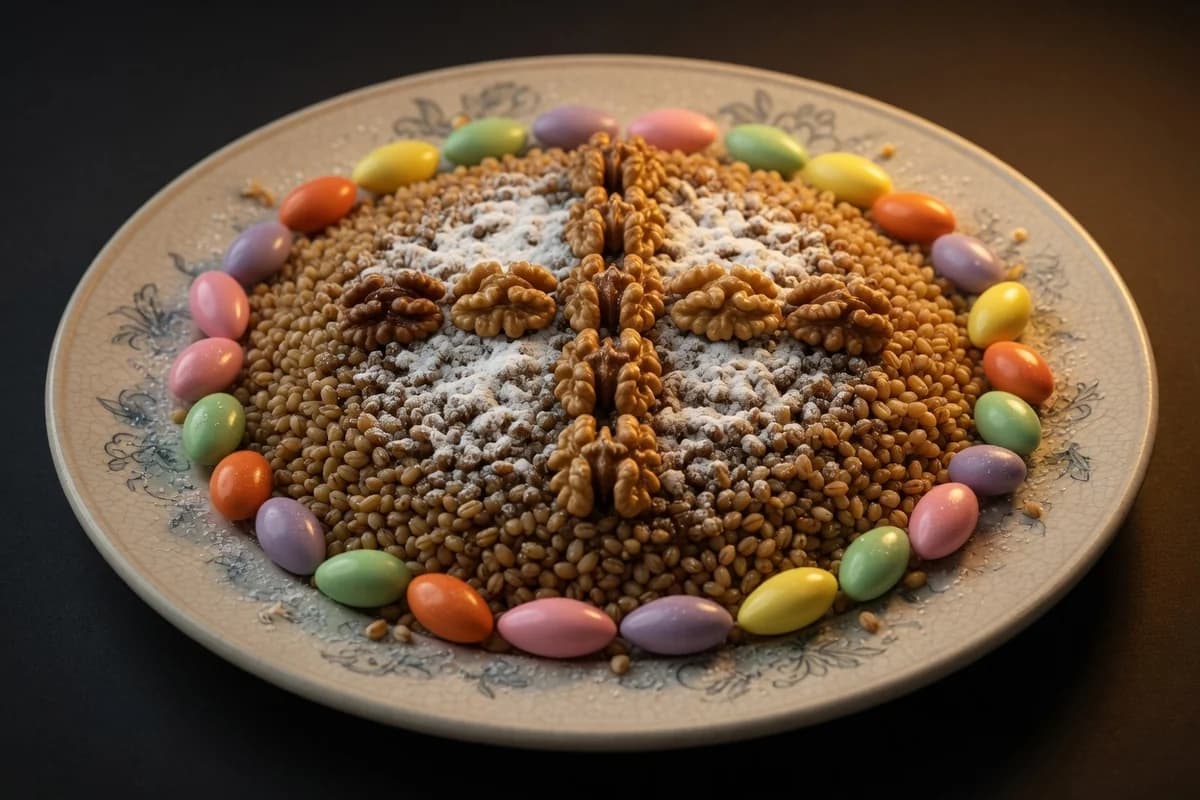
Koliva is the central element of every Orthodox commemoration. It is made from boiled wheat, sweetened and mixed with walnuts, and decorated with powdered sugar and a cross. It is blessed during the service and distributed to those present.
The symbolism comes from the Gospel: the grain of wheat, if it dies in the earth, brings forth much fruit. Koliva thus recalls the resurrection of the departed and eternal life. It is prepared for every commemoration — from the 40-day service to the annual commemorations.
What goes into koliva?
The basic recipe has a few ingredients, but every region and family has its own variations. Here is what typically goes in:
- Wheat — boiled well until soft; the base of the koliva
- Ground walnuts — mixed into the wheat for flavour and texture
- Sugar — for sweetness; sometimes honey
- Vanilla essence or lemon zest — for fragrance
- Cocoa, biscuits, or Turkish delight — in some recipes, for richness
- Powdered sugar on top — smoothed for decoration
- Sweets, walnuts, or a sugar cross — for decoration
How is koliva decorated?
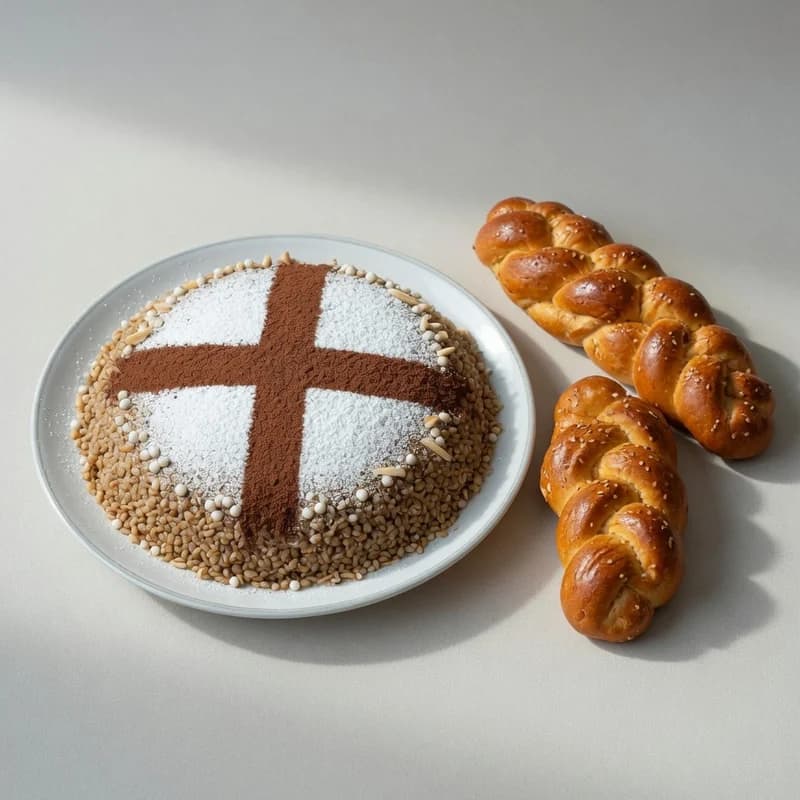
Once placed in the dish, the koliva is covered with a smooth layer of powdered sugar. A cross is made on top — from cocoa, sweets, walnuts, or coloured sugar. A candle is inserted in the centre, lit during the service.
For major commemorations, the koliva is decorated more elaborately, sometimes with the initials of the departed. For smaller ones, the decoration is simple. The cross is essential — the Christian sign that is never absent.
For which commemorations is koliva made?
Koliva is prepared for all commemorations: at the burial, at 40 days, at the monthly commemorations, at one year, and at the annual commemorations. It is also made for the Saturdays of the Dead and for the Moșii — the general days of commemoration in the Orthodox calendar.
The quantity is proportioned to the number of participants. For a large commemoration the koliva is bigger; for a small one, smaller. At memorial services we prepare the koliva according to tradition and deliver it to the church or the location of the meal.
Koliva prepared by us
For families who cannot prepare the koliva during the period of mourning, we make it according to tradition: wheat properly boiled, decorated with a cross, and delivered on time for the service.
We coordinate it together with the ritual bread and the rest of the commemoration preparations. Call us for details — the consultation is free.
The traditional recipe, step by step
Koliva is usually made the day before, so the wheat can cool and the mixture can set. The basic steps are straightforward:
- Wash the wheat and boil it in water over low heat until well softened
- Drain and leave it to cool, spread on a clean cloth
- Mix the wheat with ground walnuts, sugar, and vanilla or lemon flavouring
- Place the mixture in the dish and smooth the surface
- Cover with powdered sugar and make a cross on top
- Insert a candle in the centre for the service
| Step | What is done |
|---|---|
| 1. Boiling the wheat | The wheat is washed and boiled in water over low heat until well softened. |
| 2. Cooling | The wheat is drained and left to cool, spread on a clean cloth. |
| 3. Mixing | The wheat is mixed with ground walnuts, sugar, and vanilla or lemon flavouring. |
| 4. Placing in the dish | The mixture is placed in the dish and the surface is smoothed. |
| 5. Decorating | It is covered with powdered sugar and a cross is made on top. |
| 6. The candle | A candle is inserted in the centre, lit during the service. |
How to make the cross on koliva, step by step
The cross is the last thing you do, once the koliva is in its dish and the top is smooth. Work with the dish on a table, not in your hands. You need a small sieve or a tea strainer, a piece of card for a stencil, a ruler, and whatever you are using for the cross: cocoa, sweets, walnuts, or raisins.
These steps suit a round or square koliva of ordinary size:
- Prepare the base. Sift a thin layer of breadcrumbs or ground biscuits over the koliva and press it down lightly with a piece of card, so the surface is firm and smooth. Then sift an even layer of powdered sugar on top, at least a millimetre thick, and press it down the same way.
- Make the stencil. Use a ruler to draw the cross on a piece of card larger than the cross, then cut the cross out. Keep the card with the cross-shaped hole: that is your stencil. Keep the arms straight and the same width. A cross about two-thirds the width of the dish is easy to see and leaves room for decoration.
- Centre the cross. Lay the stencil on the koliva and measure the distance to the edge on every side with the ruler. The cross should sit straight and in the middle.
- Sift cocoa through the sieve over the hole in the stencil, slowly, tapping the rim gently with a teaspoon. Then lift the stencil straight up, without sliding it, so the edges of the cross stay clean.
- If you wish, outline or fill the cross with sweets, walnut halves, or raisins. Place them by hand or with kitchen tweezers, working from the centre out to the ends of the arms.
- Wipe the rim of the dish clean of any sugar and crumbs that fell while sifting.
- Set the candle in the centre of the cross. Put a small disc of paper or card under it so the wax does not drip onto the koliva.
Koliva cross designs
There is no required design. What matters is that the koliva carries a cross, straight and clearly visible. The shape and materials follow family and local custom. In traditional Orthodox interpretation, the sweetness on the koliva recalls the sweetness of eternal life.
Think about contrast with the base: cocoa, chocolate, and coloured sweets stand out on white sugar; white sugared almonds and white dragées stand out on a cocoa background. If the memorial falls on a fasting day, use cocoa or dairy-free dark chocolate.
Some families add the initials of the departed on either side of the cross, and sometimes the years of birth and death. These are made with small sweets or with cocoa through letter stencils. This is a custom, not a requirement. If you are unsure what is usual in your parish, ask the priest. If you would rather have a koliva ready decorated, we can prepare one for you.
| Design | How it is made | When it suits |
|---|---|---|
| Cocoa cross, with a stencil | Lay the card with the cross-shaped hole on the koliva and sift cocoa through the hole. You get a brown cross on a white background. | Any memorial; the simplest design |
| White cross on cocoa | Lay the cross you cut out of the card on the koliva and sift cocoa around it. Lift it off and a white cross remains, framed in cocoa. | Large koliva, for strong contrast |
| Cross of sweets | Outline the cross first with sweets set side by side, then fill the inside. Use dragées, sugared almonds, or coloured sweets. | Larger memorials and the Moșii |
| Chocolate cross | Sprinkle grated chocolate through the stencil, or set chocolate sweets along the outline. It softens in the heat, so decorate as close to the service as you can. | When the koliva stays chilled until the service |
| Walnut or raisin cross | Lay walnut halves or raisins tightly along the outline of the cross, or across the whole cross. | Smaller memorials; a plain look |
| Outlined and filled cross | An outline of sweets with sifted cocoa inside. The lines stay sharp and the cross can be seen from a distance. | Larger memorials, on a round koliva |
Koliva at the Moșii and the Saturdays of the Dead
Koliva is made not only for individual commemorations but also for the general days of remembrance: the Winter, Summer, and Autumn Moșii, as well as the Saturdays of the Dead during Great Lent.
On these days, the faithful bring koliva and food parcels to church, together with the pomelnic listing the names of those to be commemorated from the family. The exact 2026 dates are in the commemorations calendar.