
What "repatriating a body" actually involves
Repatriation is the legal process of shipping a deceased person across borders for burial or cremation. The rules are set by international treaties (the Berlin and Strasbourg agreements) and a layer of country-specific paperwork on top.
Practically, there are two sides to it: the side abroad — local death registration, embalming under EU or international standards, a zinc-sealed casket, the mortuary passport stamped by the Romanian consulate or the local health authority, and booking the flight or road carrier — and the Romanian side — meeting the carrier at the airport or border, clearing the deceased through customs and health authorities here, and taking them straight to the church, cemetery, or crematorium you chose. We run both sides from one phone call.
Where we bring people home from — most common routes
- From Italy — by far the most frequent route, with a large Romanian community in Lombardy, Veneto, Piedmont, Rome and Turin. Typically 3–5 days, €2,500–4,500 all-in.
- From Spain — Madrid, Barcelona, Valencia, Castellón. 3–5 days, €2,500–4,500. Air transport usually faster than road from southern Spain.
- From Germany — Munich, Berlin, Stuttgart, Frankfurt, the Ruhr area. 4–7 days, €3,000–5,500.
- From the United Kingdom — London, Manchester, Birmingham. Post-Brexit paperwork adds a day or two: 5–7 days, €3,500–6,000.
- From France — Paris, Lyon, Marseille. 3–5 days, €2,500–4,500.
- From Austria, Belgium and the Netherlands — Vienna, Brussels, Amsterdam. 3–5 days, €2,500–4,500.
- From the USA and Canada — New York, Chicago, Toronto, Los Angeles. 7–14 days because of intercontinental flights and consular processing. €5,000–8,000.
- Repatriation from the United Arab Emirates — Dubai, Abu Dhabi, Sharjah. 7–14 days. €3,500–6,500. Air cargo only. Many employment contracts in the UAE include a repatriation clause — check before you pay.
- From anywhere else — Israel, Turkey, Australia, etc. — call us with the city and we'll quote you within the hour.
How the process unfolds, day by day
Day 1–2: You call. We learn what happened, where the body is right now (hospital, home, morgue), and whether a Romanian consulate is already involved. We brief our partner funeral home in that country and they go pick the deceased up. You sign one power of attorney — sent to you by email — and that's enough to authorise us on both sides.
Day 2–4: The partner in the origin country handles local death registration, performs the embalming under EU or international standards, fits the zinc-sealed casket, and applies for the mortuary passport. If the death happened on a weekend, expect one extra day here.
Day 3–7: The Romanian consulate stamps the mortuary passport and issues the consular note required by the airline or road carrier. We book the flight or truck and confirm the arrival window with you.
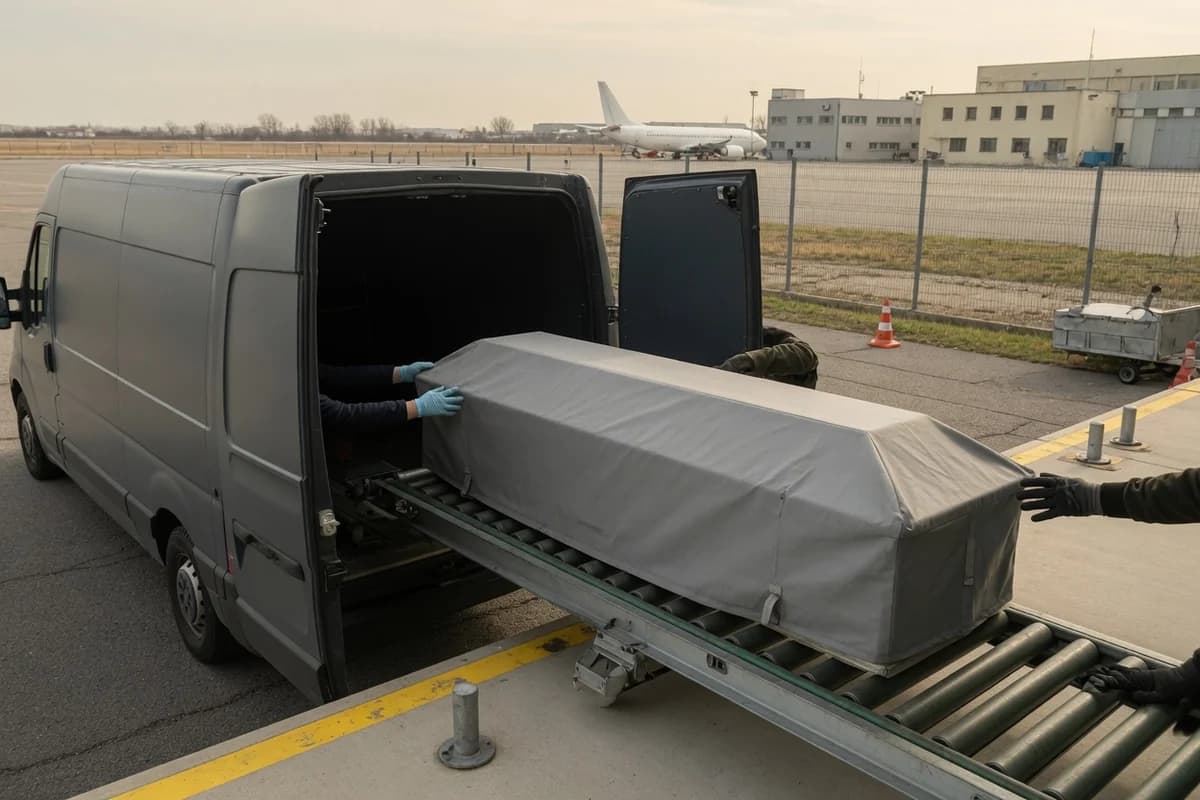
Day of transport: We're there in person when the carrier arrives in Romania — Otopeni airport for most cases — clear customs and the health inspection, and drive the deceased straight to where you've chosen to hold the ceremony.
Day of the funeral: We organise everything in Romania — church or chapel, priest, cemetery or crematorium, wreaths, the memorial meal. You don't have to coordinate vendors or chase paperwork at this stage either.
Documents we obtain on your behalf
- International death certificate, translated and legalised
- Mortuary passport — the document that lets the casket cross borders
- Embalming certificate matching EU or international standards
- Sanitary clearance for transport, both at origin and on arrival in Romania
- Consular note verbale from the Romanian embassy or consulate
- Customs and health-inspection paperwork for the Romanian airport or border
- Power of attorney you sign once, authorising us at both ends
How much it actually costs and what drives the price
Within the EU — Italy, Spain, Germany, France, Austria, Benelux — you'll spend €2,500–5,500 all-in. That covers the embalming, the sealed casket, every piece of paperwork, the flight or truck, and the pickup once we're in Romania. The cheaper end of the range is road transport from a close country; the higher end is air transport, urgency, or a remote starting city. See the repatriation costs broken down by item.
Outside the EU — the US, Canada, Australia, Asia — expect €5,000–8,000. The jump is because of intercontinental air freight, more complex consular processing, and translating documents into Romanian.
On payment: families usually pay out of pocket. Sometimes a life-insurance policy the deceased held covers part of it — we'll check that with you. The Romanian state funeral aid (9,192 RON in 2026) also applies if the person was insured or retired here; we claim it on your behalf once the deceased arrives in Romania, and it offsets the local-side ceremony costs.
Cremate abroad first — a cheaper alternative families ask about
If the deceased's wish or the family's preference allows it, having the cremation done in the country where the death happened — and then flying or shipping just the urn back to Romania — costs significantly less and is much faster. An urn isn't a casket; you don't need a mortuary passport, sealed transport, or much consular paperwork. Total cost lands around €1,500–3,000, and the urn often arrives in Romania within a week.
We can arrange this end-to-end as well — local cremation, the urn ships back, and a memorial service here. Worth asking us about if costs or speed matter for your family. For more on this choice, see our guide repatriating a deceased to Romania.