
What the mortuary passport is
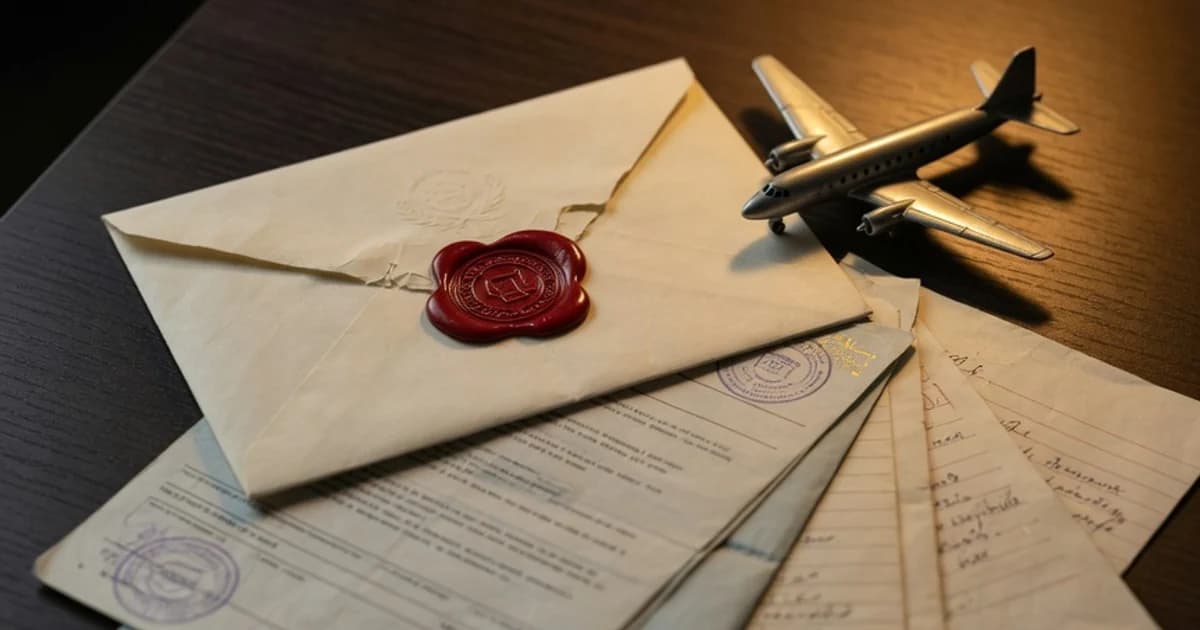
The mortuary passport is an official certificate issued by the health authority that accompanies the deceased throughout international transport. It attests that the deceased was prepared according to sanitary norms and that the transport poses no public-health risk.
The document is recognized between states under the international agreements on the transport of corpses (the Berlin Agreement of 1937 and the Strasbourg Agreement of 1973), to which Romania is a party. Because the format is standardized, border authorities in signatory countries accept it without extra formalities.
What the document actually contains
The passport records the deceased person's details and the practical details of the journey: the registration number of the funeral vehicle, the drivers' names, and the itinerary with the border crossings that must be used.
It travels with the coffin the whole way and is checked at every border. This is why the details must be exact — any change of route or carrier means the document has to be updated before departure. If you are arranging things from the UK, Italy or Spain, this is one of the details we double-check for you before the hearse leaves.
Who issues it and on what documents
For transport leaving Romania, the mortuary passport is issued by the county Public Health Directorate (DSP) or that of Bucharest. To bring a deceased into Romania from abroad, the equivalent document is issued by the local health authority or by the Romanian consulate in that country. Compliant embalming must be completed before the file is submitted.
- The death certificate (original, possibly apostilled and translated)
- The embalming (thanatopraxy) certificate, mandatory for international transport
- The sanitary transport authorization issued by the DSP
- Proof of a compliant coffin — for some destinations, a sealed metal (zinc) coffin
How the coffin is sealed
The coffin is sealed by the funeral home's staff in the presence of a DSP representative. The representative applies the seal and issues the mortuary passport based on an official sealing report.
For international transport the coffin must meet technical requirements: usually a wooden coffin with a metal (zinc) liner, or a metal coffin, fitted with a gas-purging valve and a protective mattress. The exact requirement depends on the destination country and the carrier.

When it's mandatory
The mortuary passport is mandatory for any international transport of a deceased, regardless of the means (road, air, rail). For transport within the country it is not required — there, the sanitary transport authorization suffices.
Exact requirements (coffin type, embalming, translations) vary by destination country: within the EU and Schengen the procedures are simpler, while for non-EU countries a sealed metal coffin and additional consular documents may be required.
| Aspect | Within the EU / Schengen | Outside the EU |
|---|---|---|
| Procedures | Simpler — documents are recognised more easily | Additional consular documents may be required |
| Coffin | Per the destination country's requirements | A sealed metal coffin, for some countries |
| Embalming | Mandatory for international transport | Mandatory for international transport |
| Usual duration | 3–5 business days | 7–14 days, depending on consular formalities and air transport |
EU versus non-EU destinations
Procedures differ between transport inside the European Union and outside it. Within the EU, the Berlin and Strasbourg agreements simplify recognition of the documents; outside the EU, each country's consular formalities apply. The table below sums up the usual differences — always confirm the exact requirements with the destination country's consulate.
| Aspect | EU / Schengen | Outside the EU |
|---|---|---|
| Coffin | Compliant wood, often with a zinc liner | Sealed metal (zinc) coffin with valve |
| Embalming | Mandatory for transport | Mandatory, with a thanatopraxy certificate |
| Death certificate | Translation, where needed | Apostille or legalisation + translation |
| Extra documents | Mortuary passport + sanitary authorization | + consular authorization of the destination country |
| Usual timeline | 3–5 business days | 7–14 business days |
Air transport
Airlines carry the coffin as special cargo and add their own requirements on top of the sanitary ones. They typically ask for the embalming certificate, proof that the deceased did not suffer from an infectious disease, and a sealed metal coffin packed in a transport crate.
No air carrier will accept the coffin without the mortuary passport, the apostilled death certificate and the sealing report. We book the cargo slot and handle the hand-over at the airport terminal, so the paperwork and the flight stay in sync.
Transporting ashes after cremation
For ashes, the rules are far simpler. No mortuary passport is needed: the urn travels with the cremation certificate and the death certificate, without the sanitary requirements that apply to a body.
Airlines have their own urn rules — usually a container that can be X-ray scanned, carried with the accompanying documents. Many diaspora families choose cremation precisely because it simplifies international transport.
Documents required for repatriation
Beyond the mortuary passport itself, a full repatriation involves a coordinated file: death certificate (apostilled and translated, if the death occurred abroad), embalming certificate, sanitary authorization, transport documents, and sometimes a consular authorization. The full checklist is in our paperwork checklist.
We coordinate the entire file and the transport, in parallel with the formalities in Romania. For diaspora families, we handle the Romanian end while you are still abroad.

How long it takes and how we help
For repatriations within the EU, the whole procedure usually takes 3–5 business days. For destinations outside Europe (USA, Canada, the Middle East), 7–14 days, depending on the complexity of the consular formalities and air transport.
We help with obtaining the mortuary passport and all authorizations, with compliant embalming service, with the coffin suited to the destination, and with the transport itself, door to door.