
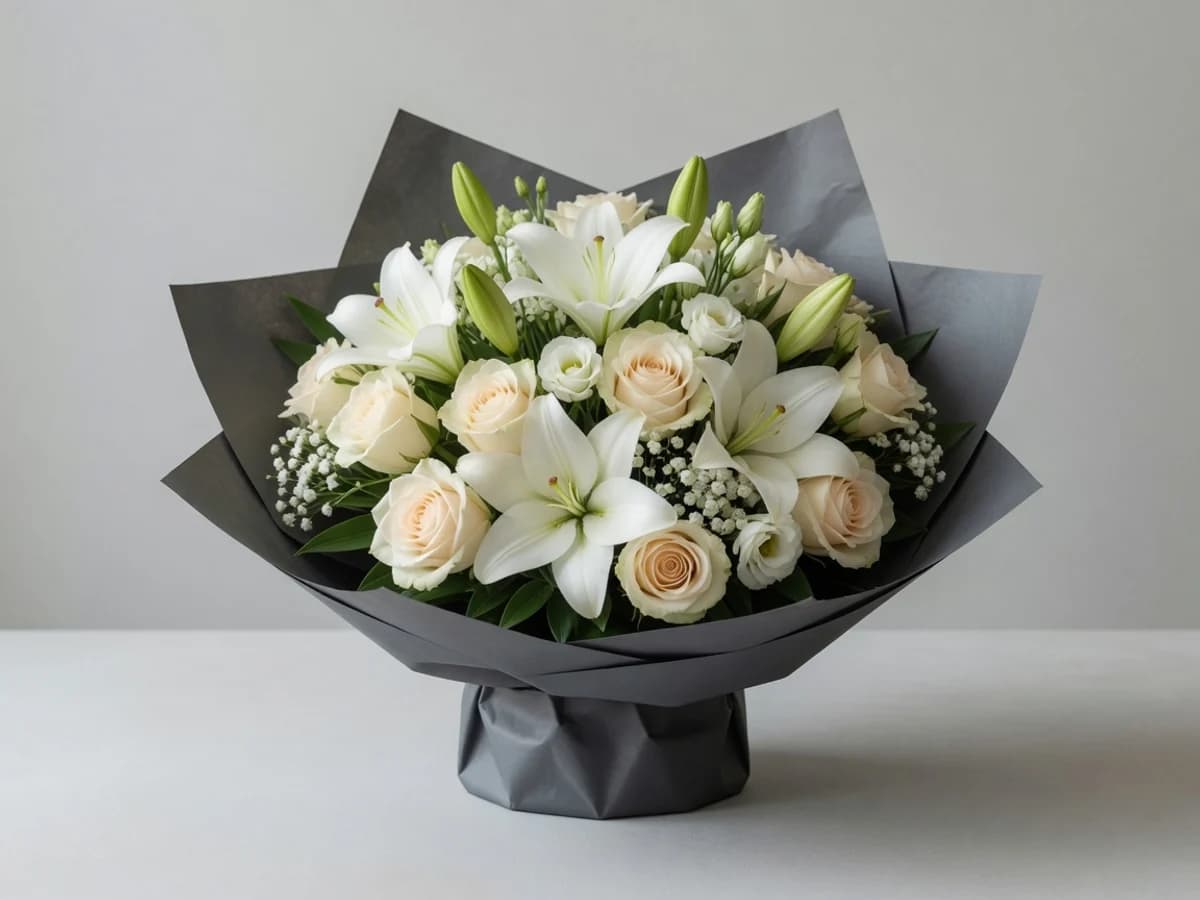
Flowers at a Romanian funeral — the basics
Flowers at a funeral are a mark of respect and compassion. They are offered as wreaths, funeral sprays, bouquets, or baskets, depending on how close you were to the deceased and the family.
The unwritten rule: the closer the relationship, the larger the arrangement. Family and close relatives bring wreaths; friends, colleagues, and acquaintances bring bouquets or sprays.
Types of funeral arrangement
Each type of arrangement has a role and a place at the ceremony:
| Arrangement | Who brings it | Where it goes |
|---|---|---|
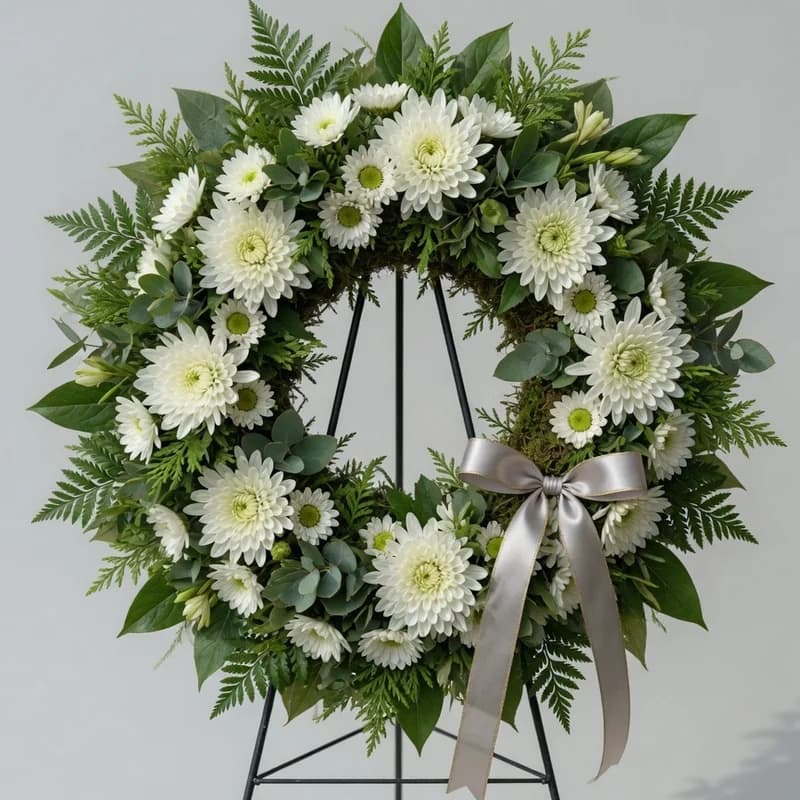
| Wreath (coroană) | Family, close relatives | At the head of the casket |
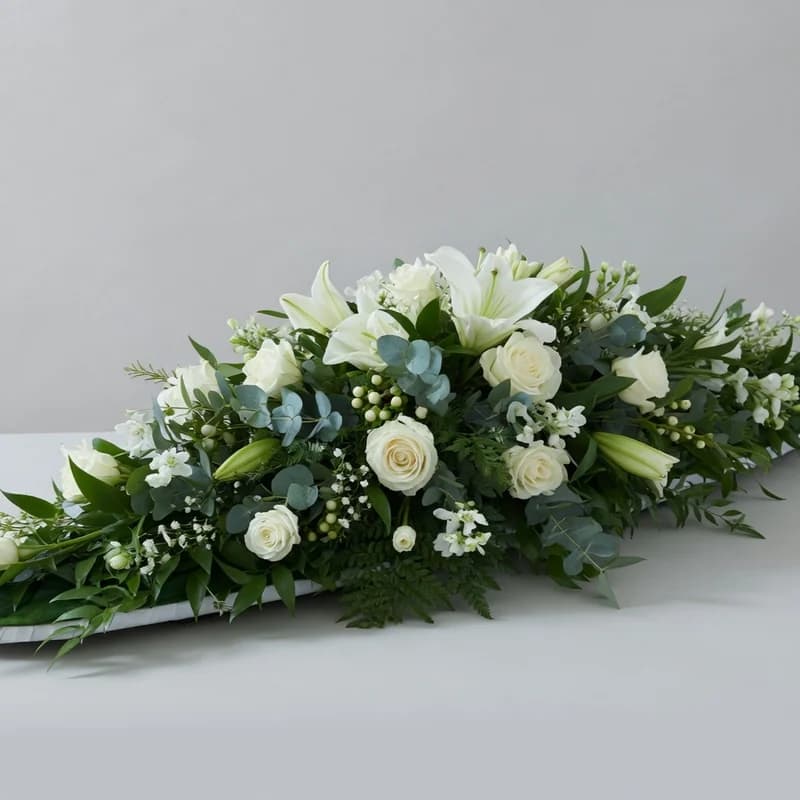
| Funeral spray (jerbă) | Friends, colleagues, organisations | On or beside the casket |
| Bouquet | Acquaintances, neighbours | On the casket or at the grave |
| Basket | Close friends, for the wake | At the chapel or at home |
Which colours and flowers to choose
Subdued tones are appropriate: white and cream convey peace and respect; lilac carries a quiet dignity; deep red signals esteem. Bright yellow and vivid multicoloured arrangements are avoided at funerals.
The most widely used flowers are chrysanthemums, lilies, carnations, roses, and gerberas. In Romania, chrysanthemums are the traditional funeral flower — strongly associated with remembrance.
- Chrysanthemums — the traditional funeral flower in Romania, long-lasting
- White lilies — for purity and peace
- Carnations — understated, widely used in wreaths
- Roses — white or deep red, for esteem
- Gerberas — for a slightly warmer arrangement, still in subdued tones
Why an even number of stems
In Romanian tradition, flowers for the deceased are given in an even number of stems. Odd numbers are for the living — birthdays, celebrations, visits. This is a widely observed custom, especially for bouquets.
For wreaths and large sprays, where flowers are tightly arranged and hard to count, the even-number rule matters less. Florists who work with funeral homes know these customs and follow them.
Who brings what
Your relationship to the deceased guides the choice of arrangement:
- Spouse and children — the largest wreath, placed at the head of the casket
- Siblings, parents, close relatives — wreaths
- Close friends — smaller wreaths or large sprays
- Colleagues and organisations — sprays with a ribbon and message
- Neighbours and acquaintances — bouquets or baskets
The ribbon message
Wreaths and sprays carry a ribbon with a short farewell message and the name of the sender. The message is sober — a few words only.
Appropriate phrases include something like 'In loving memory', 'Forever in our hearts', or 'With deepest sympathy', followed by the family name, the team's name, or the organisation. For full ribbon examples, see the guide on what to write on a wreath ribbon.
Flowers at the wake and the ceremony
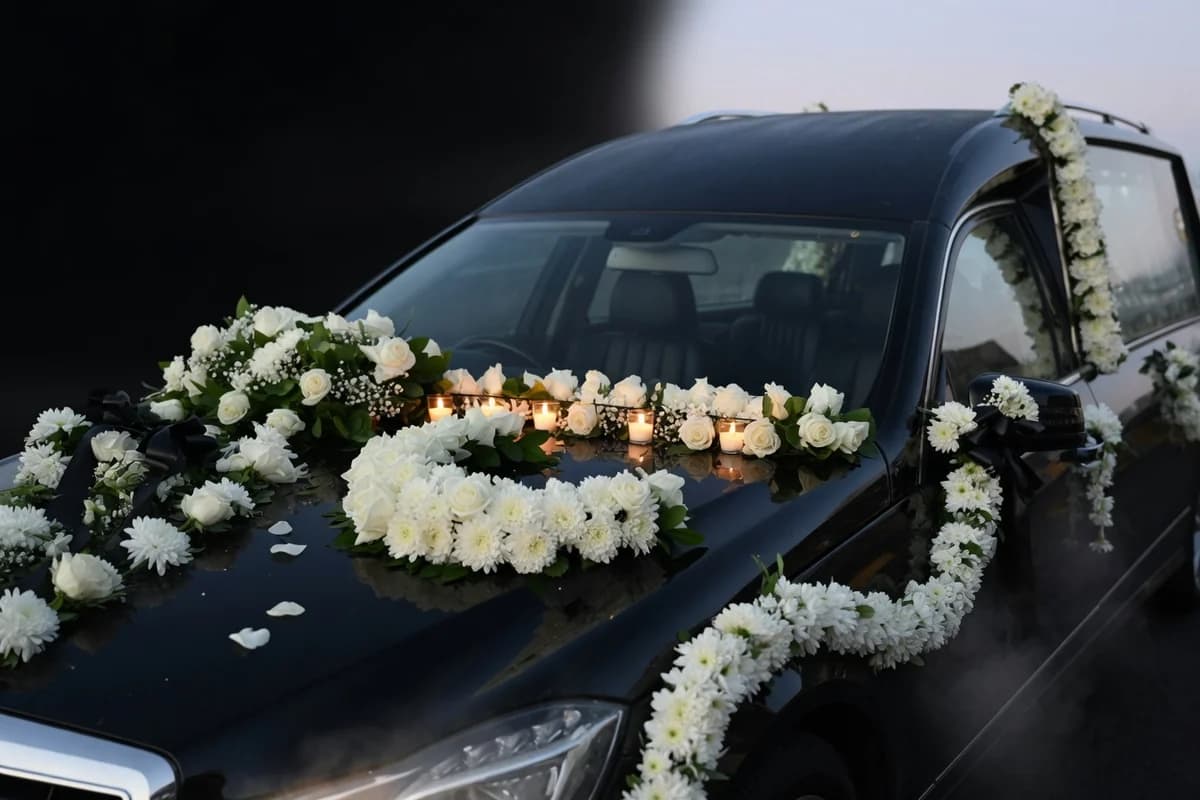
At the wake, flowers are placed around the casket, at the chapel or at home. At the church and at the cemetery, wreaths are carried in the funeral procession, ahead of or behind the hearse.
At the graveside, flowers are placed over and around the grave after the casket is lowered. Wreaths remain at the grave for a few days until they fade.
Flowers at a cremation and at memorials
At a the cremation procedure, flowers accompany the farewell ceremony beforehand, in the same way as at a burial. After cremation, flowers can be placed at the columbarium niche or wherever the urn is kept.
At the memorial calendar, smaller bouquets or cut flowers for the grave are brought alongside the koliva and ceremonial bread.
What to avoid
A few choices don't fit a funeral:
- Bright, vivid colours — sharp yellow, orange, multicoloured arrangements
- Potted plants in place of cut or arranged flowers
- Arrangements that are too small relative to your closeness to the family
- Wilted or poor-quality flowers
How to order
Funeral flowers can be ordered from a florist or directly through the funeral home, which coordinates them with the rest of the ceremony. Tell them your relationship to the deceased, your budget, and the ribbon message.
We prepare wreaths and floral arrangements and deliver them on time to the chapel, church, or cemetery. The family doesn't deal with logistics.