GUIDE · CATHOLIC FUNERAL

Catholic funeral: service, traditions and steps

A Catholic funeral has three moments: the vigil — often with the Rosary — on the evening before the burial; the Funeral Mass at church; and the committal rite at the graveside. Before death, the faithful receive the Anointing of the Sick. The Catholic Church has permitted cremation since 1963 but prefers burial, and the ashes must be kept in a sacred place. This guide walks you through each step, the differences from an Orthodox service, and how we can help.

Updated: 22 June 20261,700 wordsReviewed by Andrei
sobru.ro — Romanian funeral services
Illustrative image for the guide above.

What a Catholic funeral is

A Catholic funeral is the rite through which the community accompanies the deceased, entrusting them to God through prayer. It has three moments: the vigil, the Funeral Mass, and the graveside committal.

In Romania it applies to both Roman Catholics and Greek Catholics. The service is celebrated by a priest according to the Church's liturgical books, with the hope of resurrection at its centre.
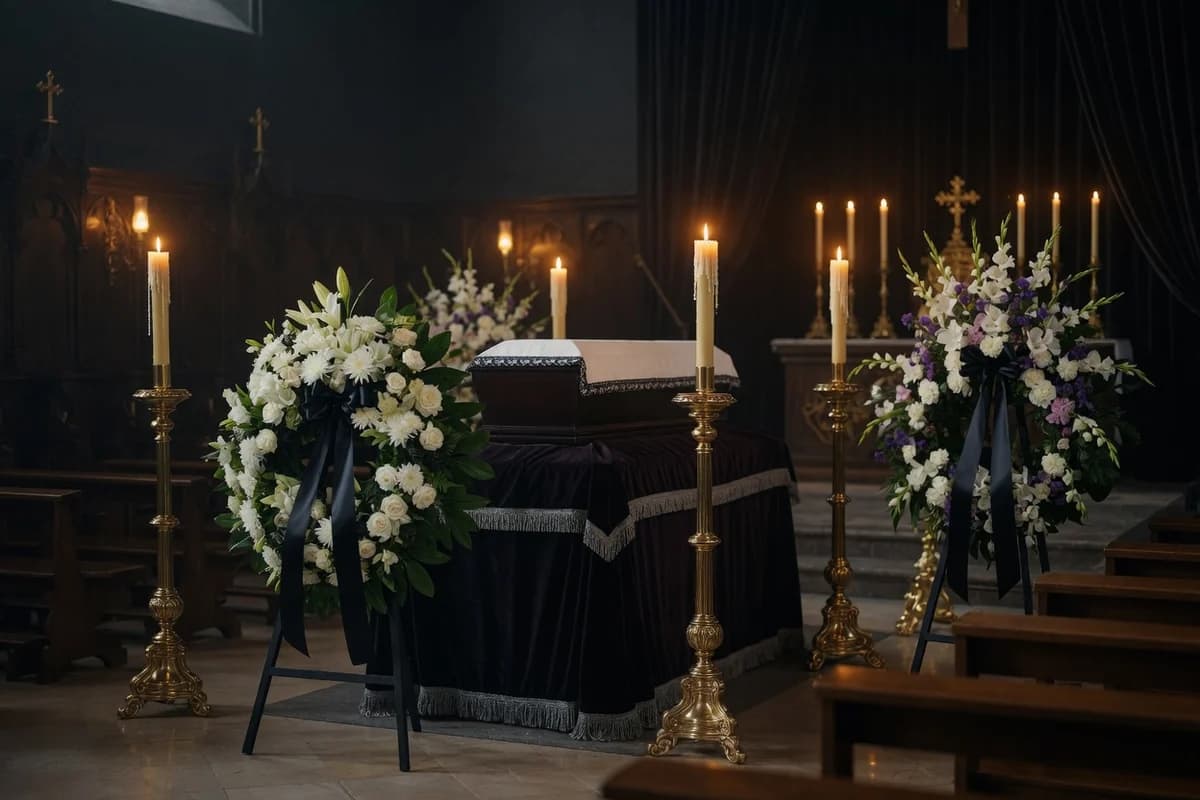
Chapel arranged for a service: tall candles, wreath stands, draped catafalque, no people
Illustrative image: chapel prepared for a funeral service.

Anointing of the Sick, before death

For a seriously ill Catholic, the priest administers the Anointing of the Sick — the sacrament through which the suffering person receives comfort and forgiveness. Confession and Holy Communion, called Viaticum, are often added.

The family can call the priest early, not only in the final moments. It is spiritual support for the patient and for those close to them.

The vigil and the Rosary

On the evening before the funeral, family and friends gather for the vigil, often with the prayer of the Rosary. It is a time of prayer and remembrance, held at the funeral home, at the church, or at home.

Scripture is read at the vigil, the Rosary is recited, and a few words may be said about the person who has died. See also arranging the vigil.

The Funeral Mass

The heart of a Catholic funeral is the Funeral Mass, celebrated at the church. It includes biblical readings, the priest's homily, prayers for the deceased, and Communion for the faithful.

The coffin is placed before the altar, accompanied by the paschal candle — a sign of the Resurrection. The Mass closes with the prayer of final commendation.
Set of natural beeswax candles tied with twine, one lit candle alongside
Illustrative image: candles burning, a sign of hope and prayer.

Burial at the cemetery

After the Mass, the procession goes to the cemetery, where the priest performs the committal rite. The coffin is lowered into the grave, the tomb is blessed, and final prayers are said.

Family and friends scatter earth and flowers. Catholics may be buried in Catholic cemeteries or, in many parts of Romania, in shared cemeteries.

Cremation in the Catholic Church

The Catholic Church lifted its ban on cremation in 1963 and permits it, provided it is not chosen as a denial of faith in the resurrection. Nevertheless, the Church prefers burial of the body.

The ashes are kept with dignity, in a sacred place — a cemetery or a columbarium — and are not scattered or kept at home, according to Church guidance.

The Holy See — Vatican

Remembering the dead — Mass intentions

After the funeral, the deceased is remembered at Mass through Mass intentions requested by the family. There is no system of memorial services (parastase) as in the Orthodox tradition, but the commemoration through Mass is equally meaningful.

2 November, the Commemoration of All the Faithful Departed — known popularly as the Day of the Dead — is the day when Catholics remember all their dead, going to the cemetery with candles and flowers.

Catholic vs. Orthodox: key differences

A Catholic funeral and an Orthodox funeral are similar in spirit but differ in their rites:

AspectCatholicOrthodox
Central serviceFuneral MassFuneral service with Prohodul
Before deathAnointing of the SickConfession, Communion
Remembering the deadMass intentionsMemorial services (parastase, 40 days, 1 year)
CremationPermitted since 1963Not practised by the Church
Catholic funeral vs. Orthodox — differences in rite.

Roman Catholic and Greek Catholic in Romania

Romania has Roman Catholic faithful — mainly in Moldavia, Banat and Transylvania — and Greek Catholics, in the Romanian Church United with Rome. The funeral rite is essentially the same, with small differences of tradition.

Greek Catholics follow a liturgy close to the Byzantine rite, while Roman Catholics follow the Latin rite. We will guide you to the right priest for your community.

How we support a Catholic funeral

We coordinate with the Catholic parish on the day and time of the Mass, prepare everything needed, and handle transport, the coffin, flowers and formalities — always respecting the Church's rite.

We are available day and night. For a no-obligation conversation, call us or see arranging the ceremony.

STEP BY STEP

Steps summary

  1. 01

    Call the priest for the Anointing of the Sick

    For a seriously ill Catholic, the priest administers the Anointing of the Sick, Confession and Viaticum. Do not wait until the final moments.

  2. 02

    Report the death and contact the parish

    Call the funeral home for collection and paperwork, then contact the parish to set the date of the Funeral Mass.

  3. 03

    Prepare the vigil and the Rosary

    On the evening before the funeral, gather the family for the vigil, often with the Rosary.

  4. 04

    Attend the Funeral Mass

    At church, the priest celebrates the Mass with readings, a homily and Communion, before the procession to the cemetery.

  5. 05

    Burial and committal at the cemetery

    At the graveside, the priest blesses the tomb and says the prayer of committal before the coffin is lowered.

OFFICIAL SOURCES

Information verified with

FREQUENT QUESTIONS

What families ask most often

  • How does a Catholic funeral work?

    In three moments: the vigil — often with the Rosary — on the evening before the funeral; the Funeral Mass at church; and the committal rite at the cemetery.

  • What is the Anointing of the Sick?

    It is the sacrament through which a seriously ill Catholic receives comfort and forgiveness. Confession and Viaticum are often added. Call the priest early, not only in the final moments.

  • Can Catholics be cremated?

    Yes. The Catholic Church has permitted cremation since 1963, provided it is not chosen as a denial of faith. However, the Church prefers burial of the body.

  • What happens to the ashes?

    They are kept with dignity in a sacred place — a cemetery or a columbarium. According to Church guidance, ashes are not scattered and not kept at home.

  • What is the Funeral Mass?

    It is the central service of a Catholic funeral, celebrated at church, with biblical readings, a homily, prayers for the deceased, and Communion for the faithful.

  • What is the vigil with the Rosary?

    It is the prayer gathering on the evening before the funeral, during which the Rosary is prayed, Scripture is read, and the deceased is remembered.

  • Do Catholics hold memorial services (parastase)?

    Not in the Orthodox sense. The deceased is remembered at Mass through Mass intentions requested by the family. This commemoration through Mass is equally meaningful.

  • What is the Day of the Dead for Catholics?

    The Commemoration of All the Faithful Departed, on 2 November, when Catholics remember all their dead by going to the cemetery with candles and flowers.

  • What is the difference between a Catholic and an Orthodox funeral?

    The Catholic central service is the Funeral Mass; the Orthodox central service is the Prohodul. Catholics use Mass intentions for commemoration; the Orthodox use parastase. Cremation is permitted for Catholics.

  • What is the paschal candle?

    It is the large candle — a sign of Christ's Resurrection — placed beside the coffin at the Funeral Mass, as a symbol of hope in the resurrection.

  • Do Greek Catholics have a different funeral?

    The rite is essentially the same. Greek Catholics follow a liturgy close to the Byzantine rite; Roman Catholics follow the Latin rite.

  • Where are Catholics buried in Romania?

    In Catholic cemeteries where they exist, or in shared cemeteries in many localities. We can help you find a suitable place.

  • How long does a Catholic funeral take?

    The Funeral Mass usually takes about an hour. Add the vigil the evening before and the committal rite at the cemetery.

  • Can an Orthodox priest lead a Catholic funeral?

    The service is led by a Catholic priest according to the Church's rite. We will direct you to the appropriate parish for your community.

  • What flowers are brought to a Catholic funeral?

    As at any Christian funeral — wreaths, sprays and bouquets in sober colours. See our guide on flowers for a funeral.

  • Can the Mass be held with the ashes present?

    The Church prefers the Mass to be held with the body present, followed by cremation. Having the ashes present at Mass is permitted under certain conditions, at the bishop's discretion.

  • What are Mass intentions?

    These are Masses requested by the family for the soul of the deceased. On the chosen date, the priest remembers the person by name at Mass.

  • Can I attend a Catholic funeral if I am Orthodox?

    Yes. Anyone may be present as a sign of respect and prayer. Communion, however, is received according to the rules of each Church.

  • What is a Requiem?

    Requiem is the Latin name for the Mass for the dead, from the first word of the opening prayer — rest. It is also widely used for funeral music.

  • Who can receive a Catholic funeral?

    Baptised Catholics. The Church may also celebrate the funeral for Catholics who had drifted away, at the priest's discretion. Ask the parish for guidance.

READ ALSO

Related guides

QUESTIONS?

Call us for guidance

We answer day and night. We explain your family's specific situation with no commercial pressure.

0739 592 835WhatsApp