Embalming (or thanatopraxy) is the procedure by which the body of the deceased is treated to be temporarily conserved and keep a dignified appearance throughout the wake and ceremony. It is performed by sanitary-certified staff, in a specialised cabin, and takes around 2–3 hours. It is recommended when several days pass before the funeral, in warm weather, and mandatory for international repatriation.
Embalming is a conservation procedure in which a special solution is injected into the circulatory system, slowing the natural processes after death. The technical term „thanatopraxy” refers precisely to the care and conservation of the deceased's body.
The purpose is twofold: to allow the family a calm wake, without haste, and to preserve a natural, dignified appearance of the loved one. The procedure is carried out with respect, by qualified staff, without the family present.
In Romania, embalming is generally done once 24 hours have passed since death, as soon as the paperwork allows. It is not done in the first hours, because the law first requires the death to be confirmed and certified.
For deaths in hospital, the rule is explicit: embalming may only take place once 24 hours have passed since death (implementing rules of Law 104/2003, approved by Government Decision 451/2004, art. 3). When the procedure is done outside a hospital mortuary or forensic service — for example, at the funeral home after a death at home — the embalmer needs approval from the Public Health Directorate (DSP). It is requested on the basis of the family's written request and a copy of the medical death certificate (Government Decision 741/2016, art. 8). That certificate is issued at least 24 hours after death — see the certifying doctor.
Why does timing matter? Until embalming, the body must be kept cold. The longer it stays without cooling, especially in summer, the harder it is to preserve it and to achieve a natural appearance. That is why we collect the deceased as quickly as possible and keep them in our mortuary cold room until the paperwork allows the procedure.
Situation
When embalming is done
Death in hospital
At least 24 hours after death
Death at home or elsewhere outside a hospital
After the medical death certificate (issued at least 24 hours after death) and DSP approval
Forensic case, with an autopsy ordered
Only after the autopsy — prohibited before it
Death from a highly pathogenic infectious disease
Prohibited — the casket is sealed and not reopened
When embalming can be done, by situation Legal basis: Government Decision 451/2004 (rules of Law 104/2003, art. 3) and Government Decision 741/2016 (art. 5, 8, and 20). We confirm the exact timing for your situation on the first call.
Is embalming mandatory? The situations where it is
Embalming is not required for every funeral. Romania's sanitary rules (Government Decision 741/2016, art. 5) require it in three situations: an open-casket viewing in a public place such as a chapel or funeral home, transport for burial in another town at least 30 km away, and cases where the Public Health Directorate requires it. For a funeral in the same town, with the wake at home or a closed casket, it is optional.
For repatriation, embalming is also a condition for issuing the mortuary passport. It becomes required or strongly recommended in the following situations:
Situation
Required?
Repatriation or international transport (any destination)
Yes — mandatory. Condition for the mortuary passport. Also requires a zinc-sealed casket.
Burial in another town, at least 30 km from the place of death
Yes — mandatory, plus a sanitary transport clearance.
Open-casket viewing at a chapel or funeral home
Yes — mandatory.
Extended wake at home (more than one night)
Recommended. Embalming prevents visible changes.
High temperatures (summer months, unventilated spaces)
Epidemiological risk, at the request of the Public Health Directorate (DSP)
Yes — when DSP requires it. For some infectious diseases DSP prohibits embalming.
Funeral in the same town, wake at home or closed casket
No — optional.
Embalming — when it is required Legal basis: Law 102/2014 and the technical and sanitary rules approved by Government Decision HG 741/2016 (art. 5, 26 and 27).
When embalming is not allowed
There are also situations where embalming cannot be done. Romania's sanitary rules (Government Decision 741/2016, art. 5) prohibit it before a forensic autopsy ordered by a prosecutor or a court, and after deaths from highly pathogenic infectious diseases, as determined by the Public Health Directorate. It is also prohibited outside authorised premises.
In these cases the casket stays closed. We explain what this means for the wake and the ceremony, and arrange everything within the law.
Repatriation cases — what families abroad need to know
When a Romanian citizen passes away abroad and will be brought to Romania for burial, embalming is always performed in the country where the death happened, before the body is shipped to Romania. Our partner funeral homes abroad carry out this step. You do not need to arrange it separately — we brief the local funeral home.
Conversely, if your relative passed away in Romania and will be transported to another country for burial, we perform the embalming here before departure. In both directions, embalming is a condition for the mortuary passport and cannot be skipped.
When it is needed
When more than 1–2 days pass before the funeral.
In warm weather, when natural conservation is harder.
When the family is spread out and needs time to gather.
Mandatory for international repatriation — zinc-casket embalming.
When an open-casket wake is wanted for several days.
Who performs the procedure
Embalming may only be carried out by staff holding a valid sanitary certification from the Romanian DSP (Public Health Directorate), under HG 741/2016. This certification covers training in thanatopraxy techniques, handling of regulated chemical substances, and proper use of sanitary equipment.
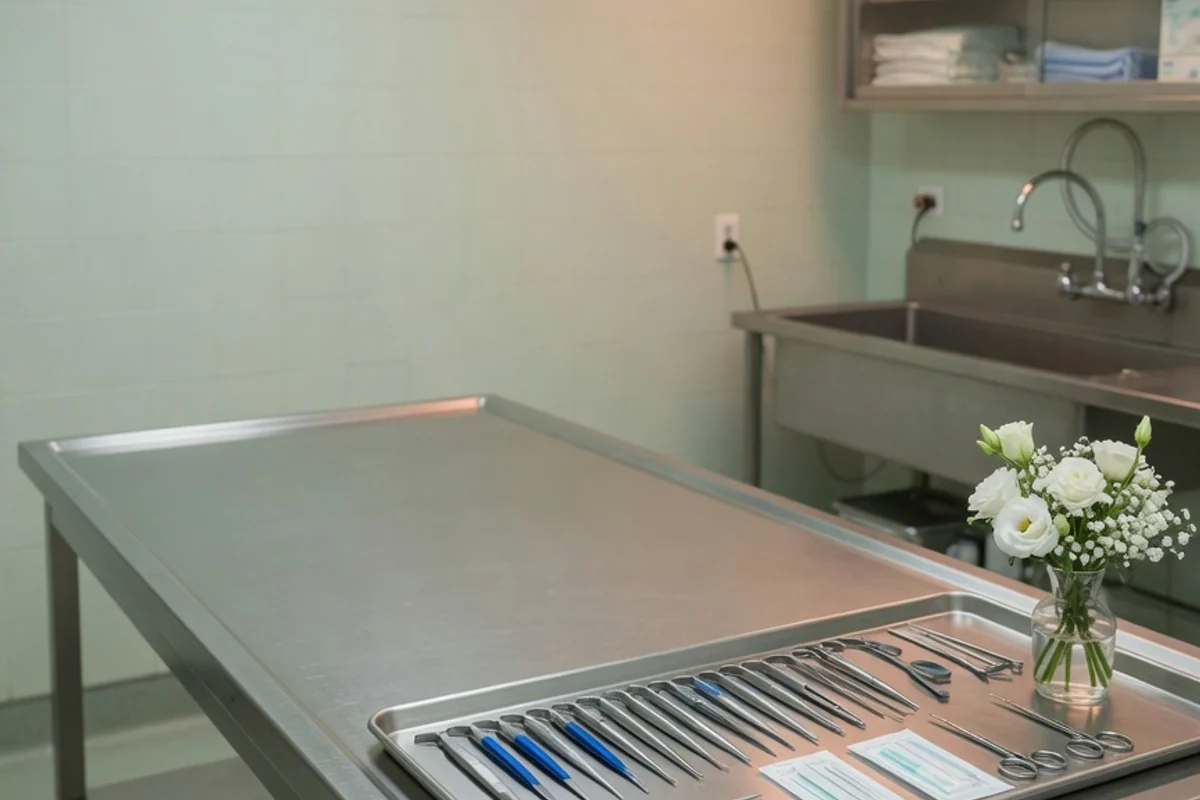
Our team has completed formal thanatopraxy training. Procedures are performed in a dedicated sanitary room — separate from any public-facing area of our premises — with controlled ventilation, proper drainage, and all required protective equipment. The room and our personnel are subject to periodic DSP inspection.
The family does not attend — the procedure is carried out privately, out of respect and per sanitary protocol. After the procedure, the deceased is dressed and presented to the family in the casket.
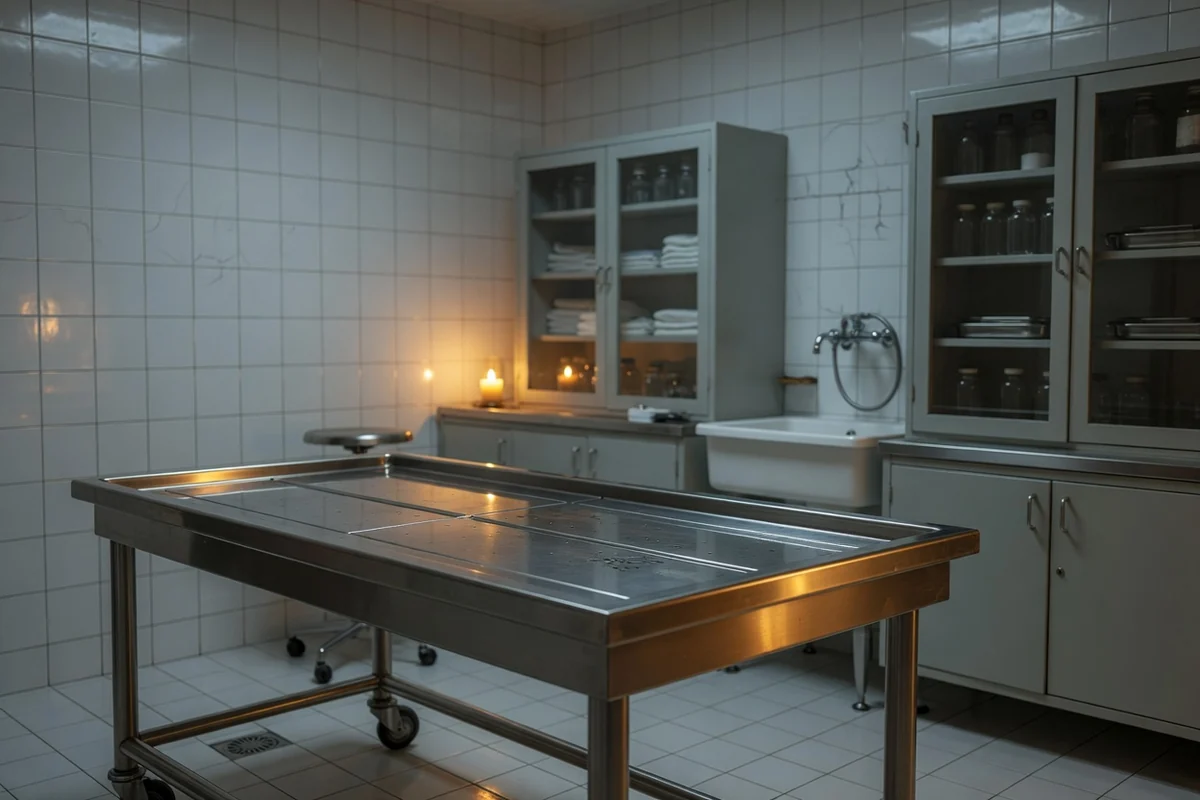
Illustrative image: the dedicated preparation cabin — ventilated, sanitary-authorized, separate from all public areas.
How it is done, step by step
The procedure is part of preparing the deceased and takes place in a specialised cabin, by DSP-certified sanitary staff. The family does not attend — they see the person only afterwards, prepared and dressed.
The products used are authorised biocides. Romanian rules require them to be used in amounts that do not preserve the body permanently, so that the soil is not contaminated (Government Decision 741/2016, art. 17). Modern embalming is therefore temporary — it covers the days until the funeral.
Checking the paperwork: the medical death certificate, the family's written request, and the Public Health Directorate's approval.
Cleansing: the body is washed and disinfected.
Setting the features: the eyes and mouth are closed and the face is given a peaceful expression. The body is laid straight, arms at the sides or folded.
Injecting the preserving solution through the blood vessels. The solution slows the natural changes after death. This stage takes 2–3 hours.
Local treatment where needed — for example, when the solution does not reach every area evenly.
Restoration and cosmetics, for a natural appearance, as if sleeping. See funeral cosmetics.
Dressing in the clothes chosen by the family and placing the deceased in the casket.
Issuing the embalming certificate, signed by the person who performed the procedure. It allows an open-casket viewing at a chapel or transport to another town.
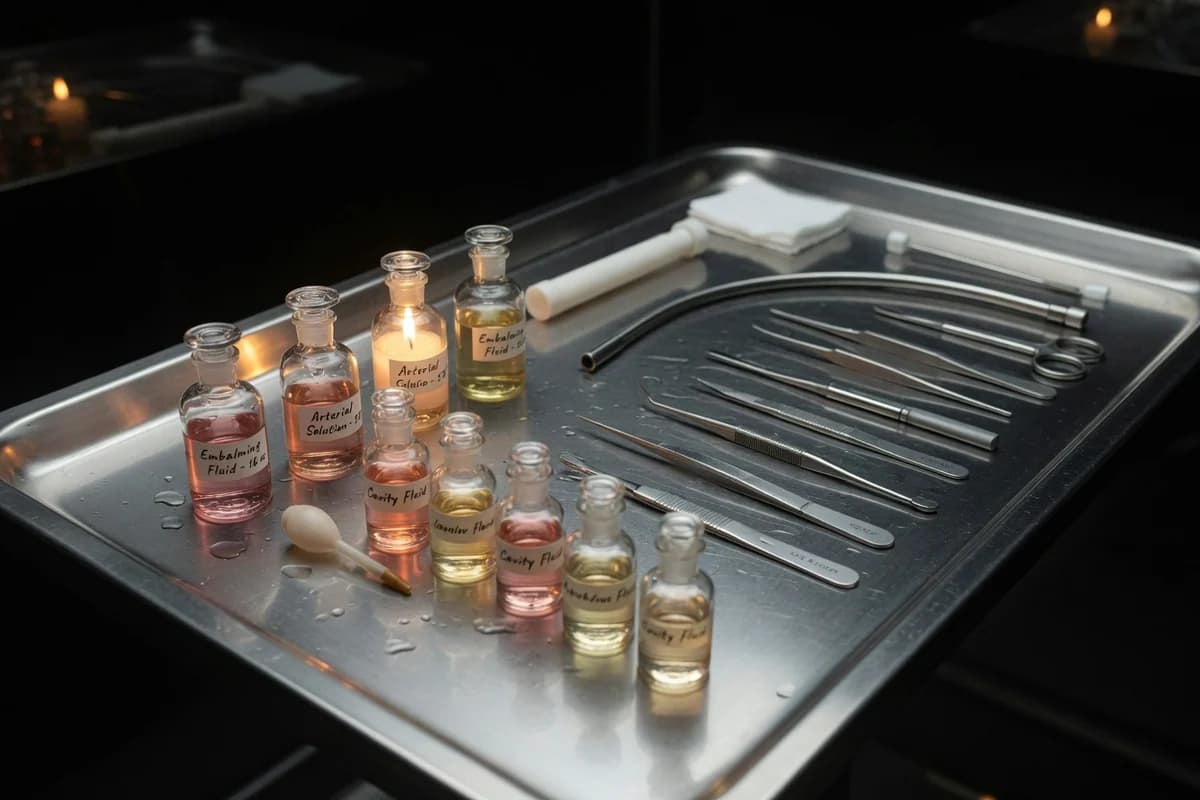
Illustrative image: the sterile instrument set used during thanatopraxy procedures, laid out on a preparation tray.
Embalming for repatriation
For international repatriation, embalming is mandatory and is done in a sealed metal casket (zinc casket), per EU and international rules. Without this treatment, cross-border transport is not permitted. We handle the entire process, including the required paperwork.
A short history of embalming
People have tried to preserve the bodies of those they loved for thousands of years. The best-known evidence comes from ancient Egypt, thousands of years ago. Egyptians removed the organs, dried the body with natron — a natural salt — and wrapped it. Their aim was to keep the body for the life after death.
Today's method came much later. In the 18th century, physicians began injecting preserving solutions through the blood vessels, once it was understood how blood circulates. In the 19th century came the chemicals that modern technique still relies on, and embalming became common, especially for bringing the dead home from far away.
The difference from Egypt is large. Then, the goal was to keep the body forever. Today, thanatopraxy has a limited purpose: a dignified appearance for a few days, hygiene for those attending the wake, and safe transport. Romanian law even requires that the procedure should not preserve the body permanently.
Embalming and religion
Religious views differ. If the family has a question of faith, the surest step is to speak with the priest, imam, or rabbi of their community. We adapt and look, together with the family, for the option that respects both the law and their faith.
Orthodox Christians: in Romania, embalming is routinely done for Orthodox funerals too — especially when the wake is held at a chapel with an open casket, where the law requires it. See also Romanian Orthodox funeral traditions.
Muslims: embalming is not practised except in cases of necessity. The body is ritually washed and buried as soon as possible. Details in our guide to Muslim funerals.
Jews: traditional Jewish law does not permit embalming. The body is ritually washed (tahara) and dressed in a shroud. Details in our guide to Jewish funerals.
When the law requires embalming (for example, for repatriation or transport of at least 30 km), we talk openly with the family and the community's religious representative. For a chapel wake, a closed casket does not require embalming.
Who performs it and what it costs
Embalming is performed exclusively by sanitary-certified staff, under Romanian Law 102/2014. With us it is part of preparing the deceased and is included in complete packages. We tell you the cost from the first call, firm and with no surprises.
LOCAL COVERAGE
Where do we provide embalming in Bucharest and Ilfov?
We cover all six sectors of Bucharest and the towns of Ilfov county. Pick your area for local details: arrival times, cemeteries and nearby landmarks.
Select Bucharest or Ilfov for local embalming pages.
FREQUENT QUESTIONS
What families ask about embalming and thanatopraxy
What is the difference between embalming and thanatopraxy?
They are practically the same. „Thanatopraxy” is the technical term for the care and conservation of the deceased's body, while „embalming” is the term used commonly. Both refer to the conservation treatment performed by certified staff.
Is embalming mandatory?
Not for every funeral. It is mandatory for an open-casket viewing at a chapel or funeral home, for transport to burial in another town at least 30 km away, and for repatriation. With the wake at home or a closed casket in the same town, it is the family's choice.
How long does the procedure take?
Injecting the conservation solution takes 2–3 hours. With cleansing, cosmetics, and dressing, the full preparation of the deceased takes around 4–6 hours.
How long does it conserve the body?
Standard embalming allows conservation for several days, enough for the wake and ceremony. For repatriation, zinc-casket embalming ensures longer conservation, required for international transport.
Does the family attend the procedure?
No. The procedure is done in a specialised cabin, by certified staff. The family sees the loved one only afterwards — prepared, dressed, with a dignified and natural appearance.
We are organizing repatriation to Romania — do we need to request embalming?
Yes. Any body transported to Romania from abroad must be embalmed before departure, as a condition for the mortuary passport. If a Romanian relative passed away in Italy, Germany, Spain, or elsewhere, the local funeral home there performs the embalming before shipment. We coordinate this with our partner abroad. If you are arranging things from Romania on behalf of a relative abroad, call us first — we will brief you on exactly what the foreign funeral home needs to do.
Is embalming needed for cremation?
National rules require it only in the usual cases: an open casket at a chapel or transport of at least 30 km. Crematoria can ask for more, though: at Vitan-Bârzești Crematorium in Bucharest, the original embalming certificate is on the list of documents for the cremation file. That is why, in our cremation package, preparing the deceased includes embalming.
How many hours after death is embalming done?
Generally once 24 hours have passed since death, as soon as the paperwork allows. For hospital deaths, the law explicitly requires at least 24 hours to pass. After a death at home, the procedure follows the medical death certificate, issued at least 24 hours after death, and DSP approval. Until then, the deceased is kept cold.
Is embalming done for Orthodox funerals?
Yes. In Romania it is a routine part of Orthodox funerals too, especially when the wake is held at a chapel with an open casket, where the law requires it. For a question of faith, ask the parish priest.
When can embalming not be done?
Before a forensic autopsy ordered by a prosecutor or a court, after certain serious infectious diseases identified by the DSP, and outside authorised premises. In these cases the casket stays closed.
RELATED SERVICES
Related services we provide
Embalming in Bucharest
Local page by district: neighbourhoods, cemeteries, collection times. 24/7 funeral home.