
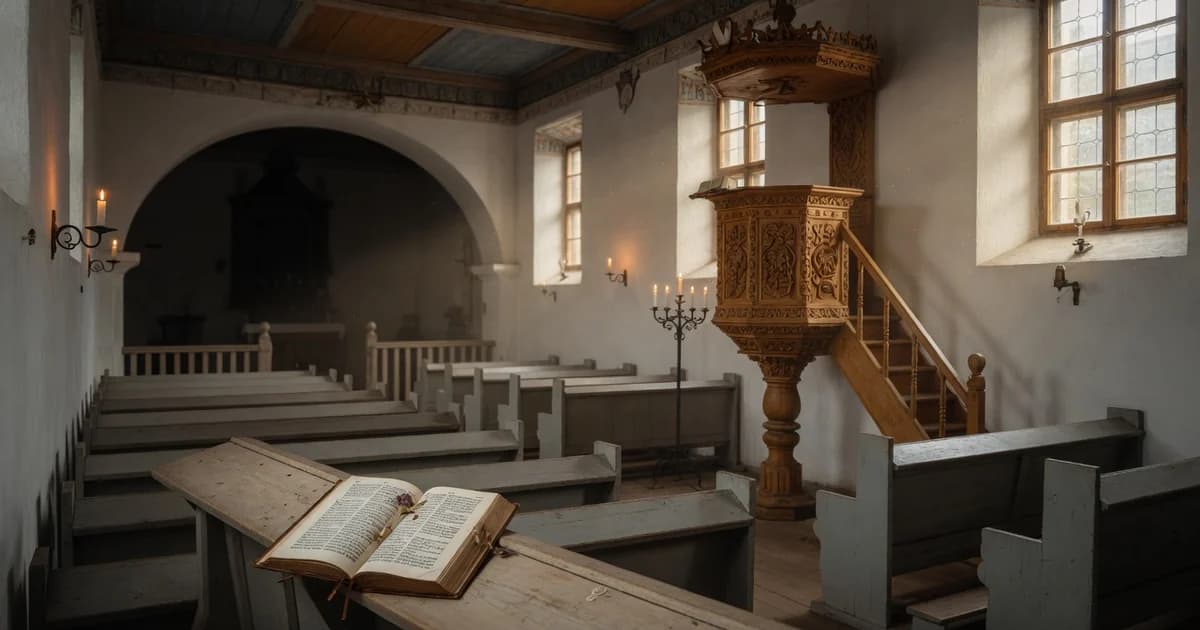
How the Reformed service works
A Reformed funeral service includes the pastor's sermon, the singing of psalms and hymns, and prayers. The church bell is rung at the time of the procession. The service may be held at the church, at a chapel or at the cemetery, depending on the tradition of the congregation and the family's wishes.
The service is usually shorter than an Orthodox funeral. The family may ask for a time when those present can speak, if the pastor and congregation agree.
There is generally no vigil in the Orthodox sense, but the community gathers to support the family before and after the ceremony. If the family wants a time of reflection before the service, they can arrange this with the pastor.

The character of the Reformed service
In the Reformed (Calvinist) tradition, the funeral service is directed toward those present — comfort and hope for the family — not toward interceding for the deceased. This is a distinctive feature of Reformed theology.
Individual congregations may have their own customs — confirm the details with the parish pastor.
In practical terms, the pastor's message is focused on the bereaved family and those present. The family may choose their preferred psalms or hymns, in agreement with the pastor.
The cantor and psalm singing
At a Reformed funeral, the cantor (kántor) leads the singing of psalms and hymns. Together with the pastor, the cantor stands at the head of the coffin, with the family and close ones gathered around. The coffin is placed on a bier, outside the home or at the cemetery chapel.
In the Reformed tradition of Transylvania, psalms and hymns are sung at the home of the deceased, along the way to the cemetery and at the graveside, until the coffin is covered with earth. Communal singing is an important part of the service.
The order of service follows the Agenda — the service book of the Reformed Church — used in the parishes of the diocese. The specific programme, psalms and hymns are agreed with the pastor and cantor before the ceremony.
Differences from an Orthodox funeral
The table below sets out the main differences for reference.
| Aspect | Reformed | Orthodox |
|---|---|---|
| Officiant | Reformed pastor | Orthodox priest |
| Language of service | Romanian or Hungarian, depending on the congregation | Romanian |
| Coliva and incense | Not used | Part of the liturgical rite |
| Memorial services | Not held at fixed dates; commemorations may take place | At established dates (3, 9, 40 days, etc.) |
| Cremation | Generally accepted; confirm with the parish | Not practised by the Orthodox Church |
Transylvania and bilingual communities
The Reformed Church in Romania is present mainly in Transylvania, with substantial communities in Cluj, Mureș, Harghita, Covasna and Bihor counties. Announcements, the order of service and discussions with the pastor may be bilingual — in Romanian and Hungarian — depending on the community.
If the family is at a distance or does not know the local Reformed parish, the funeral home can make contact with the pastor and coordinate logistics — date, time, venue, transport — without a family member needing to travel in advance.
Paperwork and practical arrangements
Administrative formalities are the same as at any death: medical death certificate from the doctor, registration of the death with the Civil Registry within 3 calendar days, official death certificate, health clearance certificate for funeral transport.
The funeral home handles all these formalities on the basis of a simple power of attorney signed by the family. The family gathers the deceased's documents — identity card, pension slip if the person was retired — and makes the decisions about the ceremony: venue, date, clothing, flowers.
Full details in the guide on obtaining the death certificate and in how a funeral is organised. If the family belongs to a Baptist community, the procedure is similar — see our guide on funerals in Baptist communities. We coordinate with the Reformed parish regardless of language and ensure transport and logistics without interruption.