
At a glance — six things to know before you arrive
- The funeral spans three days: wakes on the first and second evenings, the church service and burial on the third day, then a shared meal.
- Bring an even number of flowers. Odd numbers are given to the living; even numbers are for the dead. This is one of the most distinctive Romanian customs.
- The condolence phrase is "Dumnezeu să-l ierte" (for a man) or "Dumnezeu să o ierte" (for a woman) — May God forgive him/her. Say it to family members at the wake and again at the grave.
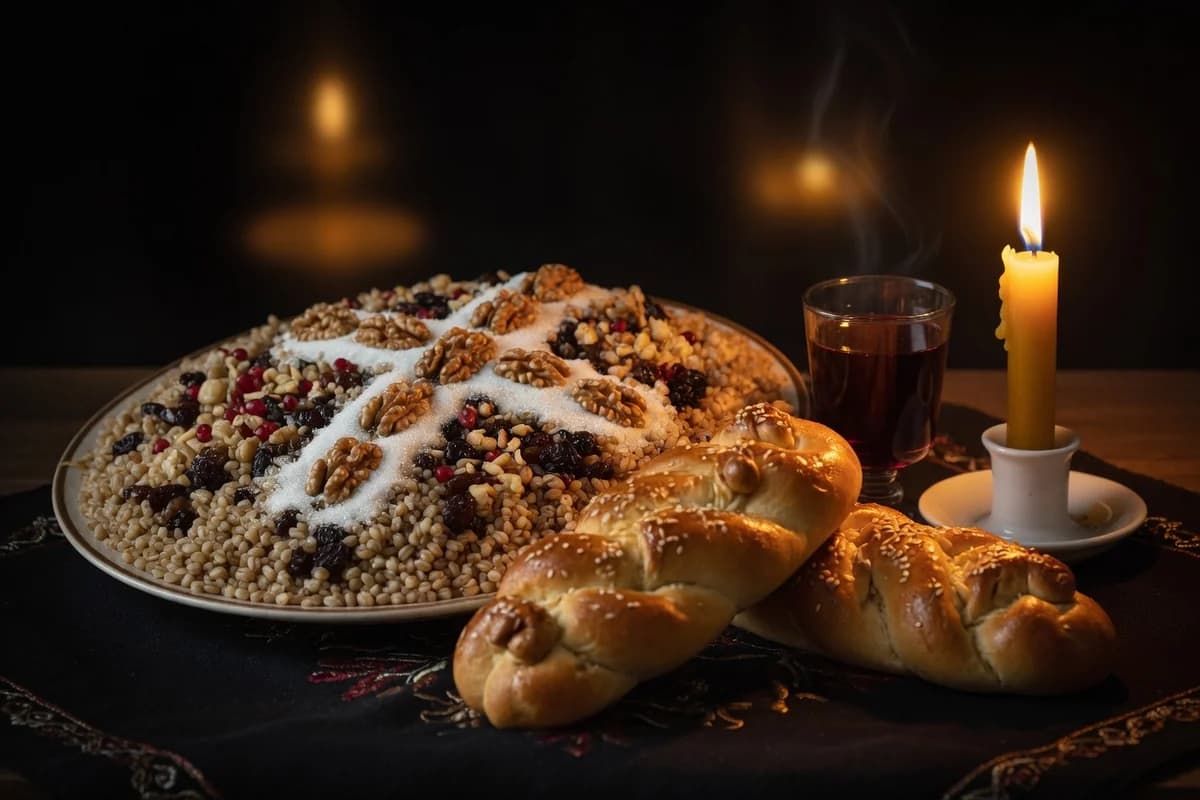
- Coliva — boiled wheat sweetened with sugar and shaped with a cross — is blessed at the church service and shared with everyone present. It symbolises resurrection.
- The 40-day memorial is the most important individual memorial; after that, memorials are held at 3, 6 and 9 months, 1 year, and every year until the seventh.
- Dress code: dark clothes throughout. Women may cover their heads inside the church in traditionally observant communities, though this varies by family and region.
The three-day rhythm
Romanian funerals follow a three-day structure that is broadly consistent across the country, though the details vary by region, family, and whether the death happened at home or in a hospital.
The first and second evenings are the priveghi — the wake. The body lies in a casket, often at the family home in rural areas or at a chapel hall in cities. Candles are lit around the casket. Family, friends, and neighbours come to pay their respects, to sit, to talk, and often to pray. There is no timetable; people arrive and leave throughout the evening. In many families someone stays with the deceased through the night — an old custom meaning the dead should not be left alone.
On the third day, the funeral service (slujba înmormântării) is held at the church. The Orthodox service is sung, not spoken, and is led by one or more priests. In traditional practice the casket remains open throughout the service. After the service, a funeral procession forms — in villages, mourners walk behind the hearse to the cemetery; in cities the procession is usually by car. At the graveside the priest says a final prayer, and family members and close friends drop a handful of earth or a flower into the grave.
After the burial, the family and guests gather for the memorial meal (pomana). This is a full meal, not a reception — hot food, wine, and the sharing of alms packets (pachete). In many parts of Romania these packets contain bread, sweets, fruit, and a small candle, given in the name of the deceased.
For families arranging repatriation or coordinating from abroad, see our repatriation service and the full repatriation guide.
Coliva and the funeral foods
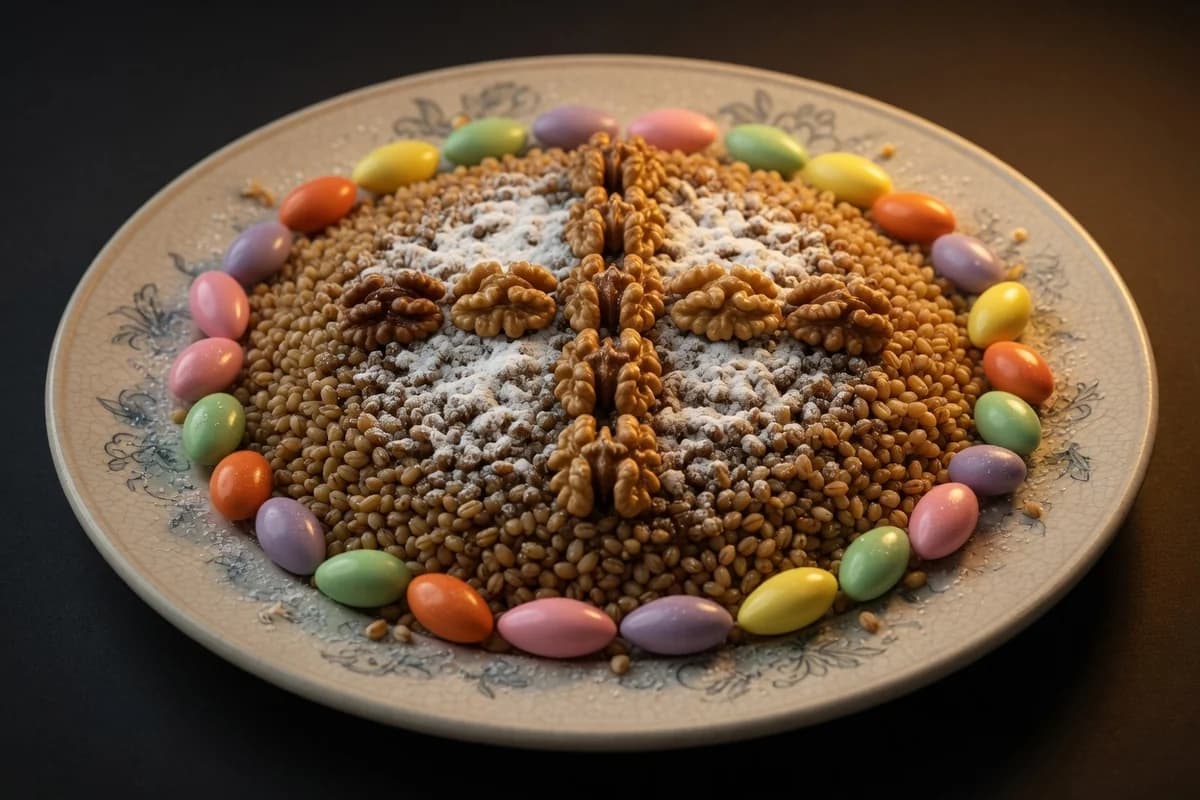
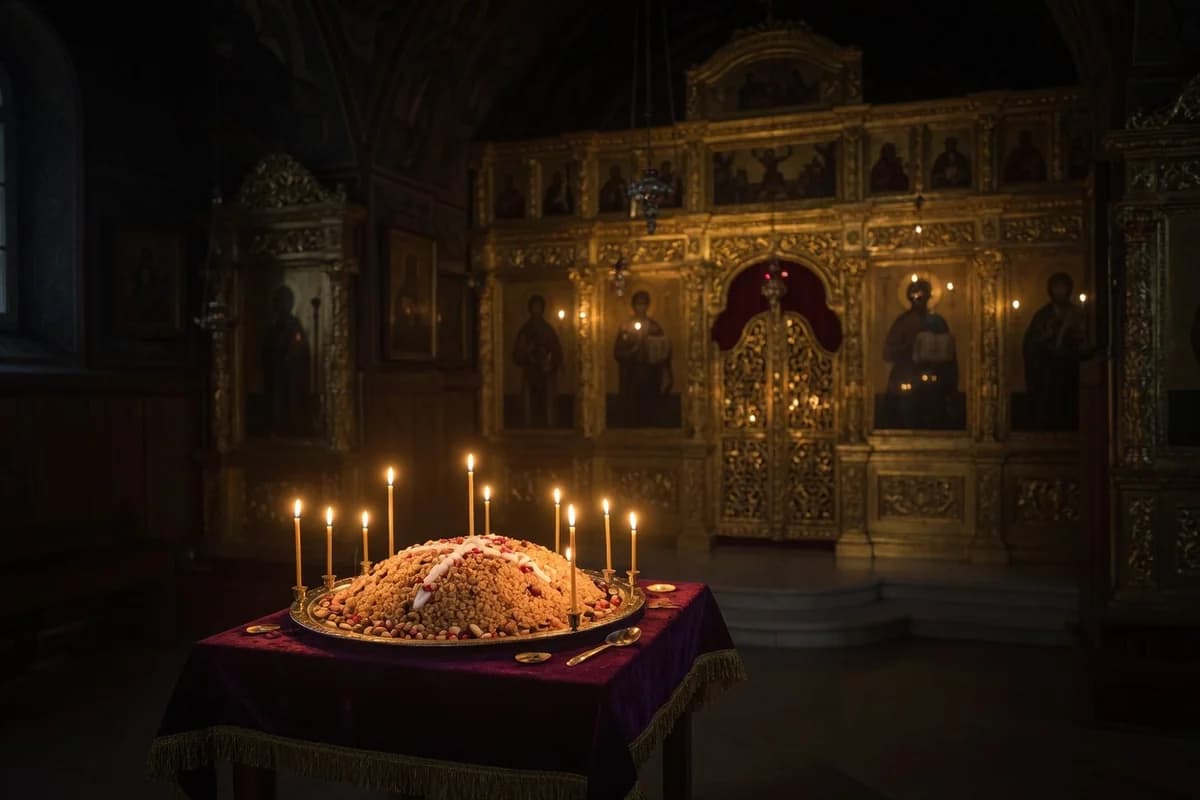
Coliva is the single most recognisable element of a Romanian funeral. It is made from boiled wheat mixed with sugar, ground walnuts, and sometimes cocoa or raisins, then shaped — usually into a mound — and decorated with a cross traced in icing sugar or chocolate. Before the church service the coliva is brought to the church, placed in front of the iconostasis, and blessed by the priest during the service.
After the blessing, the coliva is shared with everyone present. The sharing is the point: it connects the living and the dead in an act rooted in the theology of resurrection. The wheat that dies in the ground rises again — the image comes directly from the Gospel of John and is central to the Orthodox understanding of death.
At the memorial meal that follows the burial, the family serves hot food: sarmale (stuffed cabbage rolls) are traditional in much of the country, alongside soups, stewed beans, and seasonal vegetables. Wine and sometimes tuică (plum brandy) are offered. In many regions the meal ends with alms packets — small bundles of food and a candle — given to every guest to take home.
If you are not used to Romanian food, you are expected simply to eat and accept. Refusing food at a Romanian pomana can feel like declining to remember the person who died. A small helping is enough — there is no pressure to eat everything.
What to wear and what to bring
Dark clothing throughout — black is the most common choice, but deep grey or navy is also appropriate. Avoid bright colours and patterns. The standard is modest and understated: no revealing necklines, no shorts or short skirts. Men typically wear a dark suit or at minimum dark trousers and a dark shirt.
Women attending the church service may cover their heads with a dark scarf in traditionally observant families and communities. This is a sign of respect rather than a requirement, and it varies widely by family and region. If you are unsure, follow what the immediate family does.
Flowers are welcome at the wake and at the grave. The rule that surprises most non-Romanian guests: bring an even number of stems. Odd numbers are for celebrations — birthdays, weddings, visits to the living. Even numbers are for the dead. A wreath sent separately if you cannot attend is also appropriate. White flowers — lilies, chrysanthemums, white roses — are the most common choice for funerals, though the family may have preferences.
Do not bring wine or food to the wake unless the family has specifically asked; those are provided by the family. If you want to contribute, a candle to light at the wake or a small donation toward the church service is always appropriate.
What to say: condolences in Romanian
A handful of phrases covers almost every moment. The table below gives the most common ones, with a rough pronunciation guide. You are not expected to know Romanian — most Romanian families will appreciate the effort regardless of accent.
| Romanian phrase | Meaning | When to say it |
|---|---|---|
| Dumnezeu să-l ierte (for a man) / Dumnezeu să o ierte (for a woman) | May God forgive him/her | The standard phrase — said to family at the wake, at the graveside, and at any memorial. Pron. approx.: doom-neh-ZEH-oo suh-l YER-teh |
| Condoleanțe | My condolences | A more neutral phrase, also widely used and always appropriate. Pron. approx.: con-doh-leh-AHN-tsay |
| Să-i fie țărâna ușoară | May the earth rest lightly on them | Said at the grave or when remembering the person. More secular in tone. Pron. approx.: suh ee FYeh tsuh-RUH-na oo-SHWAH-ruh |
| Dumnezeu să-l odihnească | May God grant him rest | An alternative to the first phrase, used in some regions and families. |
The memorial calendar
Individual memorials (parastas) are counted from the day of death. The intervals follow a pattern consistent across Romanian Orthodoxy: 3 days, 9 days, 40 days, then 3 months, 6 months, 9 months, 1 year, and annually until the seventh year.
The 40-day memorial — parastasul de 40 de zile — is the most important individual memorial in Romanian tradition. It marks the end of the first mourning period. A church service is held, coliva is prepared again, and a meal or pomana is offered, often larger than the nine-day one. Family members travelling from abroad frequently plan to attend this one if they could not be present at the funeral itself.
In many families, during the first days after the death, mirrors in the house are covered and a candle is kept burning near where the deceased rested. These are folk customs that vary considerably by region and family — they are not church doctrine, and many urban families today do not observe them.
The 40-day memorial date can fall on a Sunday or on a major feast day, in which case it is moved to a nearby Saturday. During Great Lent, memorial services are held only on the designated Saturdays. The practical advice: confirm the date with the parish priest well in advance.
Attending from abroad
If you are in the diaspora and cannot travel in time for the funeral, a few things are worth knowing.
Romanian funerals rarely wait beyond two to three days from the death, unless there is an autopsy or a family member travelling a very long distance. Embalming allows some flexibility — up to three to four days in most cases — but the family is under practical pressure to proceed. If you are flying in from outside Europe, be realistic: the funeral may have to go ahead without you.
What you can do remotely: send flowers or a wreath through a florist in Romania; arrange a donation toward the memorial meal; attend the 40-day memorial instead, which is the second most important moment and one where your presence carries real weight. Many diaspora families manage the funeral itself with whoever is in Romania, then all return together for the 40-day memorial.
If the death happened abroad and the family wants burial in Romania, the process is a repatriation. See our guide to repatriation and our repatriation service for the timeline, paperwork, and costs. A single power of attorney is enough to authorise us to handle both countries.
You can also join family memorials by video call if you cannot travel — many families in Romania now organise this for members living in Italy, Spain, the UK, or the US. There is no rule against it, and it is increasingly common.
Church etiquette for non-Orthodox guests
Non-Orthodox guests are welcome at Romanian Orthodox funeral services. Nobody will expect you to know the prayers, the responses, or the liturgical movements.
Standing is the norm throughout the service — Orthodox churches have few or no pews. Older or less able guests are usually offered a chair, and you can ask for one without awkwardness.
At the entrance to the church and near the iconostasis there are usually candle stands where you can buy a candle for a few lei and light it for the deceased. This is one of the most natural ways to participate. Simply follow what others around you are doing.
During the service the priest will walk around the casket with a censer (tămâie — incense). When the incense reaches you, a slight bow is appropriate. At the end of the service, family members and guests approach the casket for a final farewell. Follow the family's lead — if they kiss the deceased on the forehead or the hands, you are not expected to do the same; standing quietly and crossing yourself or simply bowing is enough.
Leave your phone on silent and avoid photography inside the church during the service. Outside the church, at the graveside, family members sometimes wish to take photographs — follow their lead.